Solana’s Brand in Motion: Lessons for Building a Web3 Ecosystem
- Wuxia (Amy) Bao

- Oct 12, 2025
- 6 min read
Updated: Oct 13, 2025

Few blockchain ecosystems have evolved as rapidly—or as visibly—as Solana. Founded in 2018 by Anatoly Yakovenko, a former Qualcomm engineer, together with Greg Fitzgerald, Raj Gokal, and Stephen Akridge, Solana Labs set out to solve one of blockchain’s fundamental bottlenecks: scalability. Yakovenko’s 2017 Proof of History white paper proposed a new timekeeping mechanism for distributed systems, enabling faster consensus and throughput. Headquartered in the United States but drawing on a globally distributed engineering team, Solana’s mission was both technical and philosophical: to build a high-performance, low-cost blockchain that could rival the user experience of centralized systems while maintaining decentralization.

Solana’s differentiation from other Layer-1 blockchains such as Ethereum, Avalanche, or Polkadot lies in this performance ethos. With block times of 400 milliseconds and transaction costs measured in fractions of a cent, the chain positioned itself as “the fastest blockchain in the world.” Yet what truly transformed Solana from a protocol to a brand was its ability to translate this technical narrative into a cultural and economic ecosystem. From decentralized finance (DeFi) protocols to non-fungible token (NFT) marketplaces and mobile integration, Solana turned its performance story into a tangible brand identity: a network for builders who wanted to scale now.
Ecosystem Growth and Strategic Launches
Solana’s ecosystem expansion has been both quantitative and symbolic. By 2024, total decentralized exchange (DEX) trading volume on Solana exceeded $1.2 trillion, according to Grayscale research, while daily active wallets rose by over 300% year-on-year. The network consistently ranks among the top three blockchains by transaction count and developer activity. This momentum has been catalyzed by a robust developer ecosystem of over 2,500 active projects spanning DeFi, NFTs, and consumer apps.
Solana’s ecosystem marketing has relied heavily on proof through participation rather than traditional advertising. Every major initiative has served as both a product test and a branding statement—showing, not telling, what blockchain utility can mean in practice. Solana’s marketing strategy has evolved in tandem with the maturity of its ecosystem—moving from a developer-centric infrastructure story to a consumer-facing brand narrative anchored in usability and cultural relevance.
In its early years (2020–2021), shortly after the mainnet launch, Solana focused on proving its technical superiority through community-led ecosystem growth rather than top-down campaigns. Its initial marketing was effectively performance marketing through proof: attracting developers to build DeFi protocols such as Serum, Raydium, and Solend, which showcased Solana’s high-speed, low-cost transactions in live environments. These projects were not just applications; they were brand demonstrations—proof that Solana’s claim of “scaling for everyone” had tangible results. During this phase, Solana’s brand was synonymous with throughput and efficiency, appealing to the technical and entrepreneurial communities that formed its core advocates.
By 2022 and 2023, Solana began transitioning from an infrastructure brand to a lifestyle and consumer-facing ecosystem. The introduction of Solana Pay represented a major step in connecting blockchain technology with real-world commerce. Collaborations with brands like ASICS bridged digital and physical products—offering limited-edition NFT sneakers that merged on-chain authenticity with real-world merchandise. This was Solana’s first visible attempt to market blockchain not as financial infrastructure but as a creative enabler. Around the same time, Spotify’s Solana wallet integration pilot invited users to connect their wallets to access token-gated playlists, marking one of the earliest instances of a global entertainment company experimenting with Web3 loyalty experiences. These initiatives reframed Solana’s image: no longer just a chain for developers, but a platform for mainstream cultural interaction.
In 2023, Solana extended this narrative with the launch of the Solana Saga smartphone, a flagship effort to translate blockchain utility into physical experience. The device featured the Solana Mobile Stack (SMS), allowing users to mint NFTs, self-custody assets, and access decentralized apps through a native dApp store—without browser extensions or custodial intermediaries. For developers, the Saga phone became an experiment in lowering on-chain friction; for consumers, it embodied Solana’s core brand promise: speed, accessibility, and control in the palm of your hand. While the product’s sales volume was modest, its symbolic significance was substantial—it positioned Solana as one of the first blockchain ecosystems to bridge hardware and protocol, brand and behavior.
By 2024–2025, Solana’s ecosystem narrative had expanded into a story of multidimensional culture. Core projects like Magic Eden (NFT marketplace), StepN (move-to-earn fitness app), Helium Mobile (decentralized wireless network), and Render Network (distributed GPU computing) showcased Solana’s range—from creator economies and lifestyle apps to real-world infrastructure. Each represented a different expression of the brand: creativity, mobility, decentralization, and productivity. Together they signaled a maturing ecosystem where technology, community, and commerce coexisted as parts of a single value system.
Through this gradual progression—from high-performance infrastructure to cultural integration—Solana’s marketing evolved from claims of capacity to proofs of participation. Every stage built on the previous one: technical validation enabled ecosystem credibility; partnerships expanded cultural reach; and physical touchpoints humanized the brand. What began as a blockchain protocol has, over time, become a comprehensive brand system defined not just by speed, but by use, presence, and participation.
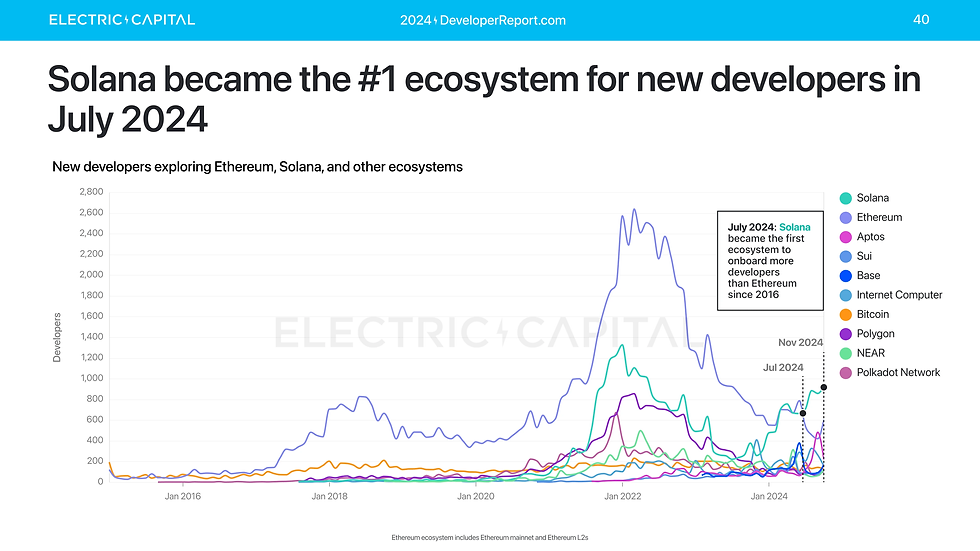
Data source: Developer report by electric capital
Narrative, Meme Culture, and the Solana Identity
In Web3, brand power is as much about narrative and culture as it is about code. Solana’s brand identity has evolved at the intersection of engineering credibility and social virality. The platform has become a favored launchpad for meme coins, leveraging its low fees and high throughput to enable viral, retail-driven communities. These projects—often humorous, self-referential, and speculative—have brought massive attention to the Solana ecosystem. In the short term, they have increased wallet creation, trading activity, and social media visibility, positioning Solana as the “people’s chain” for fast-moving retail culture.
Yet meme virality is a double-edged sword. While it amplifies awareness, it also risks trivializing the brand and associating Solana with speculative excess. The explosive rise (and collapse) of meme tokens has periodically overshadowed Solana’s more substantive ecosystem projects, creating brand volatility. This tension—between technological credibility and cultural chaos—reveals the challenge of building a brand in an environment where liquidity, identity, and humor all coexist.
At the same time, Solana’s leadership has demonstrated an unusual openness to community memes, often embracing them rather than suppressing them. This participatory tolerance has humanized the brand, fostering a sense of inclusiveness in a landscape often dominated by corporate tones. But it also underscores a deeper marketing paradox in Web3: control over brand meaning is decentralized, and reputation is co-authored by the crowd.
Bold Narratives, Media Controversy, and Brand Risk
Solana’s marketing has not shied away from ambition—or controversy. In 2025, the platform released an advertisement titled “America Is Back—Time to Accelerate”, intended to evoke a spirit of innovation and renewal. Instead, it was met with immediate backlash for its tone and imagery, leading to public apologies from co-founder Anatoly Yakovenko. The episode became a defining moment in Solana’s media journey: a demonstration of how, in Web3, authenticity and alignment with community sentiment are as crucial as creativity itself.
Some observers interpreted the campaign as a case of “controversy marketing,” where outrage generates virality. Indeed, the ad reached millions of views within hours. Yet the incident also illustrated that in decentralized ecosystems, reputation functions as social liquidity—and once depleted, it takes time to rebuild. Solana’s swift, transparent response mitigated long-term damage, but the lesson was clear: visibility without empathy can erode credibility.
Strategic Lessons for Web3 Marketers and Entrepreneurs
Solana’s journey provides a rich set of insights for marketers navigating the volatile terrain of decentralized branding. The most enduring lesson is that ecosystem performance is brand performance. Solana’s credibility stems less from its slogans and more from the behavior of its network—developers shipping products, users transacting, and communities creating culture. In Web3, every technical success doubles as a marketing event; every partnership is both a utility and a story.
Second, Solana demonstrates that incentive design is marketing design. Token rewards, airdrops, and staking yields are not mere financial mechanisms but instruments of engagement and loyalty. However, sustainable growth depends on linking these incentives to governance, reputation, and long-term value, not speculative churn. The best marketing in blockchain is participatory economics: systems that invite users to become contributors rather than consumers.
Finally, Solana’s brand evolution underscores that narrative coherence is as critical as innovation. The brand’s greatest strengths—speed, accessibility, community—can also become sources of risk when not anchored to consistent purpose. Effective communication in Web3 is therefore not about controlling the message, but about maintaining integrity across every layer: technological, financial, and cultural.
In this light, Solana’s approach to ecosystem building, hardware integration, and cultural experimentation exemplifies both the promise and peril of decentralized marketing. Its successes reveal how brand equity can emerge from transparent performance and participatory engagement; its missteps show how easily that equity can erode in the absence of alignment and humility. For Web3 marketers and entrepreneurs, Solana remains a living case study in how to turn infrastructure into identity—and how to keep that identity coherent in a world built on code and conversation.
Disclaimer: The content on this website is for marketing innovation and education purposes only and should not be considered investment advice.
Follow us
Website: www.teramy.academy
LinkedIn: linkedin.com/company/teramy-academy
Twitter: https://x.com/teramyacademy


Comments